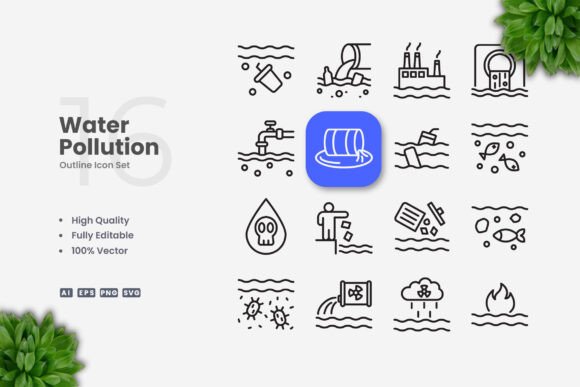
Water Pollution Icons: Clean Design for Impactful Communication
Water pollution icons are essential visual tools that help convey complex environmental issues in a simple, recognizable way. These icons are designed with clarity and precision, making them ideal for a wide range of creative and practical applications. Whether you're working on a website, mobile app, infographic, or print material, water pollution icons offer a powerful way to communicate important messages about water conservation and environmental responsibility.
The design of these icons is intentionally minimal and clean, ensuring they remain effective across different formats and platforms. Their simplicity allows them to be easily understood at a glance, which is crucial when addressing an audience that may not have specialized knowledge about environmental issues. This makes them particularly useful for educational materials, public awareness campaigns, and digital content aimed at a broad audience.
Why Water Pollution Icons Matter
Water pollution is a pressing global issue, and visual communication plays a key role in raising awareness. Icons provide a universal language that transcends cultural and linguistic barriers, making them valuable in international contexts. When used effectively, water pollution icons can highlight the consequences of pollution, promote sustainable practices, and encourage action.
These icons are not just about aesthetics—they serve a functional purpose. They help users quickly identify relevant information, such as contaminated water sources, industrial waste, or oil spills. This makes them especially useful in maps, infographics, and data visualization projects where clarity and accuracy are essential.
Creative Applications of Water Pollution Icons
Designers, educators, and content creators can use water pollution icons in various ways to enhance their work. For instance, in a website or app focused on environmental education, these icons can be used to illustrate different types of pollution and their effects. In a social media campaign, they can serve as engaging visual elements that draw attention to critical topics.
For print materials like flyers, posters, or brochures, water pollution icons add visual interest while maintaining a professional look. Their vector format ensures they remain sharp and scalable, regardless of the size or medium. This flexibility makes them a versatile choice for any project that requires clear, impactful visuals.
Mobile apps that focus on sustainability or environmental monitoring can also benefit from these icons. By integrating them into user interfaces, developers can create intuitive experiences that guide users through complex data or interactive features. The icons can act as visual cues, helping users navigate the app more efficiently.
Customization and Flexibility
One of the standout features of water pollution icons is their high level of customization. With 100% vector design, they can be resized without losing quality, making them suitable for both small and large formats. Users can easily adjust colors, stroke weights, and other details using vector software like Adobe Illustrator or CorelDRAW.
This level of flexibility allows designers to tailor the icons to match specific brand identities or project requirements. Whether you need a monochrome set for a minimalist design or a vibrant palette for a children's educational tool, the icons can be adapted to fit your needs. The ability to edit stroke weight also gives designers control over the visual emphasis of each icon.
The availability of multiple file formats—such as AI, EPS, SVG, and PNG—ensures compatibility with different design workflows. This means users can seamlessly integrate the icons into their existing projects without worrying about technical limitations. The included Readme.txt file provides additional guidance, making it easy to understand how to use and modify the files.
Practical Tips for Using Water Pollution Icons
To get the most out of water pollution icons, consider the following tips. First, ensure consistency by using the same style and color scheme throughout your project. This helps maintain a cohesive visual identity and improves the overall user experience.
Second, think about the context in which the icons will be used. For example, if you're creating content for a younger audience, you might want to use more colorful and approachable designs. For a professional setting, a more subdued and elegant style may be more appropriate.
Third, test the icons in different sizes and resolutions to make sure they remain legible and effective. This is especially important if the icons will be used in both digital and print formats. A well-designed icon should look good whether it's displayed on a smartphone screen or printed on a poster.
Finally, always keep the message clear. While creativity is important, the primary goal of these icons is to communicate information effectively. Avoid overcomplicating the design, and focus on delivering a strong, recognizable visual message.
Who Can Benefit from Water Pollution Icons?
Water pollution icons are valuable tools for a wide range of professionals and creatives. Educators can use them in lesson plans, presentations, and learning materials to teach students about environmental issues. Marketers and advertisers can incorporate them into campaigns that promote eco-friendly products or services.
Entrepreneurs and small business owners can use these icons to highlight their commitment to sustainability. By including them in marketing materials, websites, or packaging, they can build trust with environmentally conscious consumers. Similarly, bloggers and content creators can use the icons to enhance their articles, infographics, and social media posts.
Freelancers and designers can add water pollution icons to their portfolios, showcasing their ability to create effective and adaptable visual assets. Publishers and book designers can use them in educational or informational books to illustrate key concepts in a visually engaging way.
Ultimately, water pollution icons are a practical and versatile resource that can be used by anyone looking to communicate environmental issues clearly and effectively. Their clean design, ease of customization, and wide range of applications make them an invaluable addition to any creative or professional toolkit.